Service News
Copyright By FCA Italy S.p.A. - Printed 04/08/2017


Ducato


Version: All versions (250 and 290) Middle East markets
00
008.17
0000 0 000 AA MAINTENANCE OF VEHICLES IN STOCK (Middle East)
Methodology for carrying out preliminary maintenance on stored units, particularly at Dealership compounds - Network Information.


This Service News cancels and replaces the following documentation:

- CD ROM "Management and maintenance of vehicles in stock" - General Standards (procedure CO.35.3).

- Service News 00.08.03 of 20/02/2003.

- Service News 00.30.04 of 23/04/2004.

- Service News 00.04.10 of 12/03/2010.

- Service News 00.04.10 of 29/10/2010.

- Service News 00.06.12 of 11/07/2012.

INTRODUCTION

This Service News provides the main instructions to be followed for parking, storage and maintenance of new vehicles in compounds; prolonged periods of storage and incorrect movement can lead to damage.

Any damage leads to higher repair and restoration costs and taints the brand reputation.

The aim of this procedure is to prevent possible damage caused by improper storage/movement of vehicles

1. GENERAL STANDARDS FOR COMPOUND ARRANGEMENT

1.1 Specifications for the storage area

To ensure the best possible conditions for vehicles in storage, the vehicle storage and transit areas must meet the following basic specifications.

  1. The ground surface must have draining capacity, be compact and stable; ideal conditions include a compound floor made entirely of asphalt or cement. As an exception for the vehicle parking area only, a stable and compact draining gravel surface is allowed; in this case, the driving lanes must be made of asphalt or cement. An earth or grass surface should be avoided;
  2. Trees/bushes or any other type of vegetation should be avoided near the vehicle storage area. If there are trees within the compound, a space must be provided between the trees and the storage area to prevent any chemical attack from plant residues, pollen, etc.
  3. The structure must comply with environmental regulations in force;
  4. There must be no building sites (special protection measures may be necessary in the case of temporary works);
  5. There must be no waste water on the storage area surface; for this reason, it is necessary to arrange for a water drainage system or sloped surface to favour and ensure an outflow;
  6. Transit routes and level differences (thresholds, ramps) must be made without excessive discontinuity that might lead to impact and damage to the underbody.

1.2 Clothing of personnel working in storage areas

The clothing of personnel working in or passing through the storage areas must comply with the safety regulations in force. High-visibility trousers and jackets are recommended, without any buttons, rivets, buckles, rings, etc.

1.3 Equipment and tools for the storage areas

The storage areas should comply with the following requirements:

  • loading/unloading lanes on the compound surface must be clearly marked, with suitable numbering displayed on vertical and/or horizontal signs (white or yellow lines);
  • parking spaces:

- are marked out with vertical and/or horizontal lines (white or yellow lines);

- are large enough so that the doors can opened without touching the moving parts of adjacent vehicles;

- have alphanumeric numbering on vertical and/or horizontal signs (white or yellow lines), so that the vehicle can be immediately traced;

  • availability of an IT system for management/identification of stored vehicles, containing a set of data to allow the following to be immediately managed/recognised:

- the vehicle location within the compound;

- the vehicle status (e.g. being dispatched/to be repaired, etc.);

- the maintenance already carried out/to be carried out on the vehicle;

  • with vehicle protection and safety in mind, it is preferable to install hail nets in the area where the vehicles are stored:
  • availability of a sheltered building to house administration/operational offices
  • availability of a washing service for vehicle wax/film removal (the area must be equipped in compliance with the safety regulation in force); the area must have pressure spray lances or a pressure washing system, with the brushes disabled (except for brushes with expandable bristles having mixed polyethylene and cloth composition, for example, Carlite model).

Washing and wax/film removal must be carried out in an enclosed area or under a sheltered area, in order to ensure sufficient shade for the vehicle.

  • availability of a raised platform for washing and/or wax/film removal for roof/sunroof of vehicles whose height exceeds 1.50 m; the platform should have a step in accordance with the safety regulations in force;
  • availability/possibility of access to a set of tools/services for maintenance, including:

- interior cleaning

- high-pressure washer

- battery charging equipment, e.g. FGA UNIVERSAL BATTERY CHARGER (part number 2000039600), CTEK MXS 10 FCA or equivalent

- battery tester, e.g. MIDTRONICS EXP 813 FGA tester (part number 2000037000), MIDTRONICS XL513 or equivalent, or

- integrated equipment (battery charger + tester) e.g. MIDTRONICS GRX 3228 FGA (part number 2000035900), MIDTRONICS GR-1 240 or equivalent

- emergency booster, with 12 V output voltage;

- tools for correct tightening according to the brand repair manuals, with suitable accessories (e.g. digital torque wrench with calibration/update certificate).

1.4 Alarm system for the storage areas

An intrusion protection system must be guaranteed in the vehicle storage area (security and surveillance system)

At least the following features are required:

  • suitably strong external fencing
  • suitable night lighting for the compound area

1.5 Storage area maintenance

The storage areas must be subject to regular maintenance to prevent grass, moss, gravel, holes, nails, accumulation of anti-ice salt and all elements that might puncture tyres and/or cause damage to painted parts.

Special maintenance is required on components subject to rust and on all equipment close to stored vehicles (ramps, slides, structure for hail nets, etc.).

2. REGULATIONS FOR MANAGING VEHICLES IN STORAGE AREAS

2.1 Vehicle parking rules

Vehicles must be parked in the storage areas to ensure:

  • immediate access to areas containing fire-fighting equipment;
  • an inspection lane and a walkway running along the length of the perimeter of the area.

In addition, vehicles must be parked within the area in strict compliance with certain conditions to:

  • prevent adjacent vehicles from touching and damaging each other;
  • allow the vehicles to be moved easily;

Vehicle parking must comply with the following rules.

  • minimum clearance between bumpers allowing them to exit from the parking area with a single steering manoeuvre;
  • minimum clearance between sides to allow at the moving parts of at least one of the vehicles to be opened completely;
  • closed windows and roofs, luggage compartment lid (boot, tailgate or swing doors) closed;
  • side doors and side sliding doors closed;
  • windscreen/rearscreen wipers lifted (excluding all models where this operation is structurally impossible due to vehicle constraints);
  • sun roof and/or soft top closed;
  • the fuel flap closed and the fuel filler cap present and if not, renewed;
  • vehicles must have the handbrake released and the shift lever:

- in the P position for automatic transmission;

- in first gear for manual transmission;

- in first gear or R for robotised, Dualogic, DFN or Selespeed transmission;

- in the P position for Twin Clutch Transmission (TCT);

  • Batteries should be immediately deactivated when parking vehicles in stock (including all undeliverable vehicles); the clamp should be disconnected from the negative pole (if there is a quick release positive clamp, the clamp should be removed from the positive pole);
  • door mirrors must be closed;
  • the keys must be placed in the ashtray or in the driver's side pocket (with the metal part folded inside the casing);
  • vehicles with a cloth covering and chassis must be kept indoors or have protective covers to prevent water penetration due to the weather. If storing indoors, the areas must be sufficiently ventilated;
  • vehicles with "cracked windows" or that are "not working", and vehicles with moving parts that do not close properly, resulting in water penetration, must be kept indoors or the damaged parts must be suitably protected while awaiting replacement/repair;
  • vehicles that are fouled with excrement, oils or other corrosive substances, salt or surface rust must be washed before being stored: both vehicles that are not waxed nor protected by films and vehicles that are waxed or protected by films, but have evidence of fouling on the unprotected parts, must be washed (before washing, ensure that windows, glass panels, the sun roof and/or the soft top, boot, bonnet and doors are closed).

2.2 Rules for moving vehicles in the storage area

The following is strictly prohibited:

  1. improper use of vehicles;
  2. pushing vehicles;
  3. pushing vehicles while operating the starter motor;
  4. revving the engine at high speeds;
  5. using compound vehicles for towing or transporting passengers and/or materials;

Boosters may be used for certain emergencies in the compound; if the booster has 12 V or 24 V output voltage switch, it is necessary to ensure that the applied voltage is 12 V (to avoid irreparably damaging the electronic control units) and to avoid inverting the polarity when connecting the booster to the vehicle battery (to avoid irreparably damaging the alternator).

If the vehicle has catalytic converters, this leads to higher temperatures in the exhaust systems; for this reason, they should not come into contact with potentially flammable materials such as dry leaves, paper or flammable oils.

2.3 Maintenance for vehicles in the storage areas

The following is strictly prohibited:

  • applying marks or any other forms of identification to the bodywork;
  • resting any kind of item on the bonnet, wings and the roof;
  • dry-rubbing the vehicle exterior;
  • writing on the bodywork;

For maintenance in the storage areas, the vehicles in the compound must also be washed whenever they are fouled by excrement (e.g. bird guano), atmospheric or chemical attack (e.g. cement powder), oils or other corrosive substances (e.g. surface rust from rail transportation). Both vehicles that are not waxed nor protected by films and vehicles that are waxed or protected by films, but have evidence of fouling on the unprotected parts, must be washed (before washing, ensure that windows, glass panels, the sun roof and/or the soft top, boot, bonnet and doors are closed).

The scheduled maintenance operations are described below


Operations


Months


3


6


9


12


15


18


21


24


Check/restore battery charge


X


X


X


X


Check/restore tyre pressure


X


X


X


X


Remove wax/protective films


X


Replace fuel filter


X


X


Replace oil filter


X


X


Change engine oil


X


X


Change fuel


X


X


Change brake/clutch fluid


X


Regular checks


(*)


(*)


(*)


(*)


(*)


(*)


(*)


(*)

(*) Regular checks

Every 3 months

Start the engine and run it for 30 minutes checking its behaviour.

Check engine oil pressure until operating temperature is reached (approximately 80 °C) and that there no leakages (lubricant oil, fuel, coolant).

Start the engine as shown in the Owner Handbook with particular care if the checks are performed in critical environments.

Check the tension of belts and respective pulleys.

Visually check:

  • engine (rust, jammed components, etc.)
  • fluid level (lubricant oil, coolant)
  • exhaust system pipes (silencer connections)
  • cooling system pipes (radiator connections)
  • intake system pipes (intercooler connections)
  • wiring conditions.

Every 12 months

Start the engine and idle it for 5 minutes, then accelerate gradually to reach operating temperature (approximately 80 °C).

Check that there are no leakages (lubricant oil, fuel, coolant) and perform all the tests prescribed every 3 months.

For replacement of liquids (engine oil, fuel and brake/clutch fluid),use the prescribed products listed in the Owner's Handbook and on the Technical Assistance Manual.

2.4 Checking the battery charge/recharging

2.4.1 Vehicles in stock

To check battery charge status:

  1. first check that there are no active devices (e.g. interior lights on);
  2. measure the voltage at the battery terminals with the pole disconnected and the battery at rest (neither charged by the alternator, nor flat due to starting/devices) for at least two hours;
  3. define the battery charge status according to this scan:
  • if the voltage is below 12.10 V, the battery must be replaced; in this case, it will be replaced during vehicle consignment;
  • if the voltage is between 12.10 V and 12.49 V, the battery must be recharged;
  • if the voltage is greater than or equal to 12.50 V, the battery is considered charged;

Batteries that have been checked and then recharged after one year will no longer be subject to further maintenance except during vehicle consignment.

To remove the battery, refer to the dedicated service procedures.

To avoid serious damage to the battery or possible explosion, the following precautions must be adopted:

  • keep naked flames, lit cigarettes, unprotected lights, etc. way; batteries under charge produce an explosive mixture of hydrogen and oxygen gases;
  • keep the charging area well ventilated; deactivate the rectifier before disconnecting the clamps;
  • if the battery is recharged on the vehicle, all lights and accessories must be switched off and the earth lead disconnected;
  • avoid rapid recharging with either series or parallel connections.

2.5 Check/restore tyre pressures

To check the tyre pressure status:

1. make sure that the tyre inflation pressures of the various model are within the following storage values:

  • Fiat Ducato or successors: 5.0 – 5.6 bar;
  • Fiat Ducato Camper or successors: 6.0 – 6.6 bar;
  • all other vehicles: 2.7 – 3.3 bar;

2. if the measured value is lower than the minimum required value or if the measured value is higher than the maximum required value, restore the tyre pressure accordingly, by inflating or deflating it;

3. if the tyre is punctured, replace it immediately.

2.6 Wax removal

Wax must be removed in an enclosed area or under a sheltered area, in order to ensure sufficient shade for the vehicle (the surface temperature of the vehicle must be from 15°C to 25°C).

While preparing and applying the solution, the operator must wear PVC gloves and goggles and must not add other products to the wax removal solution (shampoo, polish, etc.).

The wax removal steps are described below:

1. make sure that all openings on the vehicle are closed:

  • windows, glass panels, sun roof and/or soft top;
  • boot, bonnet and doors are closed to the second click;

2. spray the vehicle exterior surface uniformly using spraying equipment that does not excessively nebulise the solution. Leave the product to act for 5 minutes, making sure that the surfaces do not dry out (it is necessary to respray the areas where the solution has evaporated in the meantime);

3. remove the protective layer by rinsing the surface with plenty of pressurised water, respecting the following conditions when using a water lance:

  • water temperature < 30°C;
  • operating pressure < 110 bar;
  • minimum distance from the body surface = 40 cm;
  • the jet should be directed almost at a right angle to the surfaces concerned.

2.7 Film removal

To protect the vehicle paintwork, an alternative to the waxing process is the application of self-adhesive plastic films to selected parts of the vehicle; films can be applied to the vehicle for either standard/partial coverage or total/extended coverage.

Films must be removed in an enclosed area or under a sheltered area, in order to ensure sufficient shade for the vehicle (the surface temperature of the vehicle must be from 15°C to 30°C - if required, wet with water so that the vehicle surface temperature is close to this temperature range):

1. peel up the outer edges of the film and remove it;

2. make sure that all openings on the vehicle are closed:

  • windows, glass panels, sun roof and/or soft top;
  • boot, bonnet and doors are closed to the second click;

3. wash the vehicle to remove any deposits left on the bodywork while removing the film, using pressure washers or pressure washing systems with deactivated brushes or compliant/certified brushes;

4. inspect the protected surfaces and remove any adhesive residues with a soft cloth (any marks at the edges or in areas where the film was unevenly applied, such as folds or bubbles, usually disappear 24/48 hours after removal).

ANNEX I - FRONT END

BRACKET CONNECTING FRONT END TO SIDE PANEL/STRUT

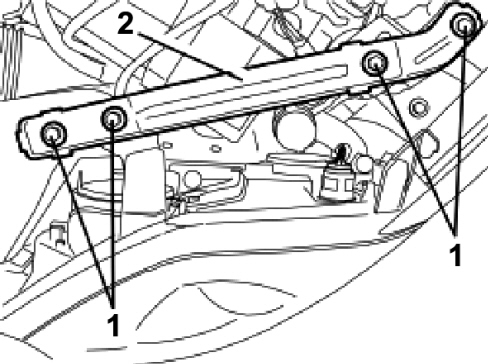
REMOVAL procedure (Fig. I.1)

After opening the bonnet:

  • undo the screws (1) securing the bracket (2);
  • remove the bracket (2);
  • lay down the disassembled components without damaging them.

Figure I.1


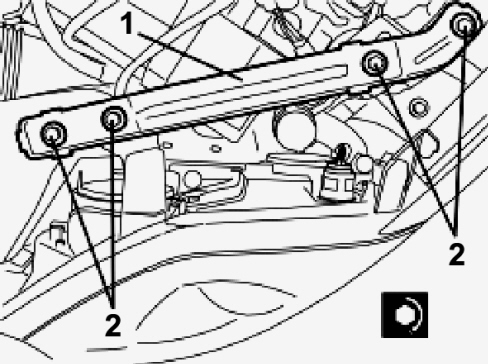
REFITTING procedure (Fig. I.2)

After checking that the bracket is not damaged:

  • fit the bracket (1) and tighten the screws (2);
  • tighten the screws according to the torque shown in the table (Table I.1).

Table I.1


Component


Fastening


Ø


Value (daNm)


Front end reinforcement bracket


Screw


M8


2.0 – 2.4

Close the bonnet lid.

Figure I.2


ANNEX II – PROTECTIONS

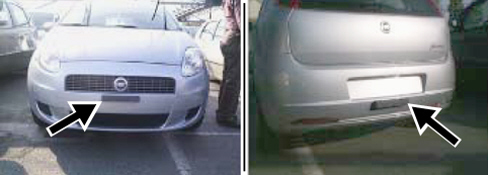
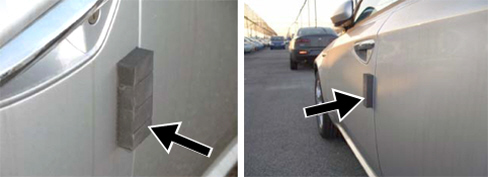
All means of protection are described below, with an explanatory picture to show the correct position.

BUMPER buffers (Fig. II.1)

Figure II.1


EXTERNAL DOOR buffer (Fig. II.2)

Figure II.2


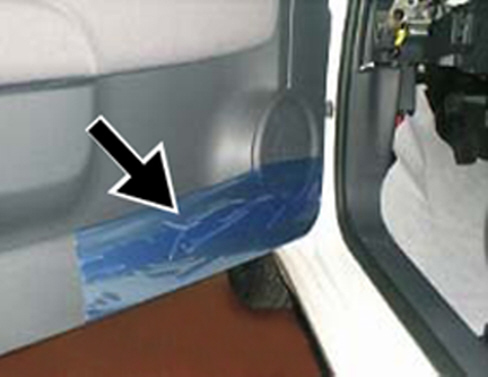
DRIVER'S INTERNAL SIDE DOOR plastic liner (Fig. II.3)

Figure II.3


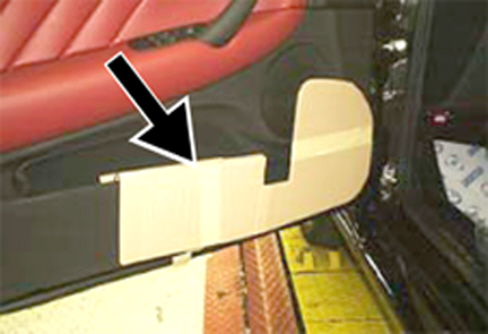
DRIVER'S INTERNAL SIDE DOOR cardboard (Fig. II.4)

Figure II.4


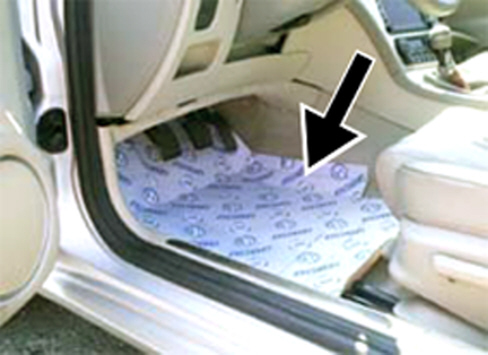
DRIVER'S FLOOR MAT cardboard (Fig. II.5)

Figure II.5


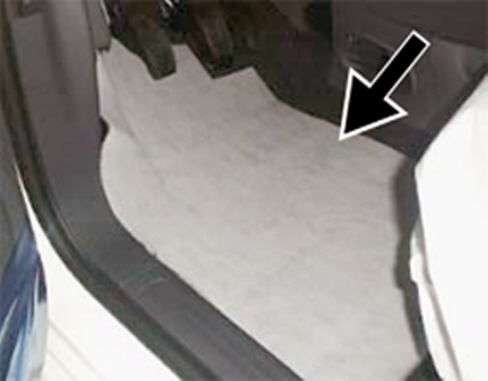
DRIVER'S FLOOR MAT ribbed plastic (Fig. II.6)

Figure II.6


DRIVER'S SEAT cover (Fig. II.7)

Figure II.7


Door opening seals - STICKERS (Fig. II.8)

Figure II.8


All means of protection must be removed by the dealer before consignment to the customer.

ANNEX III - IT SYSTEM AND CHECKLIST

The compound IT system must include the following records:

  • MODEL CODE;
  • CHASSIS CODE;
  • VEHICLE LOCATION IN THE COMPOUND (alphanumeric location code);
  • DATE OF FIRST ALLOCATION;
  • ACCEPTANCE DATE;
  • DATE OF FILM/WAX REMOVAL;
  • DATE OF ANY WASHING;
  • BATTERY MAINTENANCE DATE;
  • BATTERY MAINTENANCE WORK (replacement, recharge, OK);
  • TYRE PRESSURE MAINTENANCE DATE;
  • TYRE PRESSURE MAINTENANCE WORK (restoration, OK).

The checklist placed inside the vehicle must include the following fields:

  • MODEL CODE;
  • CHASSIS CODE;
  • DATE OF FIRST ALLOCATION;
  • ACCEPTANCE DATE;
  • VEHICLE CONDITION (Stock, dealers, EUMI, Major Damage - Vehicle not repaired as new);
  • BATTERY CHARGE CHECK/RECHARGE DATE AND RESULT (to be replaced, recharge, OK);
  • TYRE PRESSURE CHECK/ RESTORATION DATE;
  • WAX/FILM REMOVAL;
  • DATE OF ANY WASHING.

ANNEX IV - MIDTRONICS EQUIPMENT

Follow the instructions in the related Service News.

ANNEX V - MAINTENANCE DUE TO OXIDATION

This annex contains a table summarising the maintenance to be carried out on the engine compartment and underbody when the vehicle spends more than the recommended time in the compound (based on geographical location and environmental conditions).


CLASS


GEOGRAPHICAL LOCATION - ENVIRONMENTAL CONDITIONS


STORAGE TIME WITHOUT MAINTENANCE


SPECIFIC MAINTENANCE FOR THE ENGINE COMPARTMENT / UNDERBODY (if storage will continue)


EXAMPLES


A


MORE THAN 3 km FROM THE COAST

DRY CLIMATE


UNLIMITED


NONE


MANDRAS


B


MORE THAN 3 km FROM THE COAST HUMID TEMPERATE CLIMATE


12 MONTHS


APPLICATION OF PROTECTIVE WAX TO THE ENGINE COMPARTMENT AND UNDERBODY


NONE


C


MORE THAN 3 km FROM THE COAST HUMID COLD CLIMATE


10 MONTHS


APPLICATION OF PROTECTIVE WAX TO THE ENGINE COMPARTMENT AND UNDERBODY


ANTWERP


D


0.3 km TO 3 km FROM THE COAST


6 MONTHS


- WASHING AND DRYING

- APPLICATION OF PROTECTIVE WAX TO THE ENGINE COMPARTMENT AND UNDERBODY


PORTBURY


E


ON THE COAST - SHELTERED (GULF, BAY)


1.5 MONTHS


- WASHING AND DRYING

- APPLICATION OF PROTECTIVE WAX TO THE ENGINE COMPARTMENT AND UNDERBODY


CORK


F


ON THE OPEN SEA COAST

HUMID/SALINE CLIMATE and TROPICAL CLIMATES (with a rainfall of more than 2000 mm a year)


5 DAYS


- WASHING AND DRYING

- APPLICATION OF PROTECTIVE WAX TO THE ENGINE COMPARTMENT AND UNDERBODY


ESBJERG

ANNEX VI – VEHICLES DAMAGED BY EXCEPTIONAL EVENTS

If vehicles are damaged by exceptional events within the Dealership storage areas (except for any stored cars in consignment), procedure specifications provided directly by the department Technical Services must be followed.

Exceptional event means a sudden and unexpected event (according to the relevant insurance policy taken out by the company), which might be

  • of natural origin (hail, flooding, inundation, breaking sea action, tornadoes, hurricanes and heavy storms, lightning, earthquake, tsunami, etc.);
  • of other external origin (strikes, vandalism and wilful damage, disorders and riots, fires, explosions and blasts, etc.).

ANNEX VII – POST PDI VEHICLES

Vehicles subject to PDI (Pre-Delivery Inspection) and returned to storage must respect all prescriptions and have

  • a protective buffer on the driver's door exterior
  • seat protection
  • floor mat protection

These vehicles must also be washed whenever they are fouled by excrement (e.g. bird guano), atmospheric or chemical attack (e.g. cement powder), oils or other corrosive substances (e.g. surface rust from rail transportation).

The table shows the scheduled maintenance for this type of vehicle:


Operations


Months


3


6


9


12


15


18


21


24


Check/restore battery charge


X


X


X


X


Check/restore means of protection


X


X


X


X


Replace fuel filter


X


X


Replace oil filter


X


X


Change engine oil


X


X


Change fuel


X


X


Change brake/clutch fluid


X


Regular checks


(*)


(*)


(*)


(*)


(*)


(*)


(*)


(*)

(*) Carry out the prescribed maintenance (see chapter 2.3 above).

For replacement of liquids (engine oil, fuel and brake/clutch fluid),use the prescribed products listed in the Owner's Handbook and on the Technical Assistance Manual.